
A lengthy chapter can feel overwhelming—especially when several subjects are waiting for your attention. You may read every page, highlight important lines, and still struggle to decide what to revise before the exam.
The solution starts with turning the chapter into clear, organised notes that help you explain concepts and answer questions.
Whether you are studying UG or PG this guide will help you create short, exam-ready notes without losing essential information.

1. Understand the Chapter Before Shortening it
Before writing notes, read the chapter to understand its main idea. If a topic feels difficult, work through an example or watch a relevant learning video before summarising it.
During this first reading, ask yourself:
- What is this chapter about?
- What are its main concepts?
- How are these concepts connected?
- Which parts can I explain, and which need another reading?
For example, before preparing notes on working capital, make sure you understand current assets, current liabilities, and the operating cycle.
A short note should remind you of something you understand.
2. Use Your Syllabus to Decide What Matters
Check the chapter against your syllabus and learning objectives. Use previous question papers, where available, to understand how topics have been assessed.
Look for material such as:
- Definitions and key terms
- Features, objectives, and functions
- Advantages and limitations
- Differences between related concepts
- Processes, stages, and classifications
- Formulas and numerical methods
- Applications and case examples
Previous papers can guide your practice, but they cannot guarantee what will appear in the next exam. Keep every topic required by your syllabus in your revision plan.
3. Turn Headings into Questions
Give your note-making a clear direction by changing each chapter heading into a question. Then write a short answer using the key points from your textbook.
For example, if you are studying Principles of Management, you could turn these headings into questions:
| Chapter heading | Question to answer |
|---|---|
| Meaning of planning | What is planning? |
| Importance of planning | Why is planning important for a business? |
| Steps in planning | What steps are involved in the planning process? |
| Limitations of planning | What are the limitations of planning? |
Under each question, include a definition or brief explanation, followed by the essential points. Add an example wherever it makes the concept easier to understand.
Try it: Cover your answer and explain the topic aloud. If you miss an important point, review it and try again.
These questions give you a ready-made self-test for revision. Practise expanding your brief answers when preparing for longer exam questions.
4. Write Keywords with Enough Explanation
One of the biggest mistakes students make while preparing short notes is either copying entire paragraphs from textbooks or reducing everything to just a few words. Both approaches can make revision difficult.
The key is to find the right balance between short notes and meaningful explanations.
Instead of writing lengthy paragraphs, identify the important keywords, concepts and phrases from each topic. Explain each point in two to three simple sentences using your own words. This will make your notes shorter, easier to understand and more useful during exam preparation.
For example:
Topic: Delegation of Authority
Instead of copying a lengthy textbook explanation, prepare your notes like this:
- Meaning: Delegation refers to assigning tasks and responsibilities to subordinates.
- Authority: The subordinate is given the necessary authority to complete the assigned task.
- Accountability: The manager remains ultimately accountable for the overall results.
This format helps you remember the important elements while giving you enough information to develop a complete answer in the examination.
Remember: Good study notes are not simply about writing fewer words. They are about expressing important concepts clearly, accurately and in fewer words.
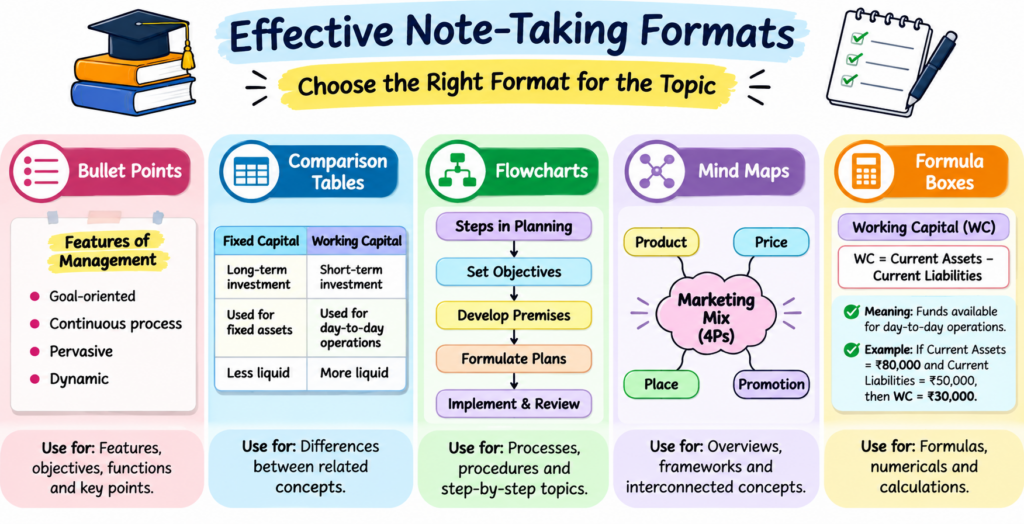
5. Choose a Format That Fits the Topic
Not every chapter can be summarized using the same note-taking method. Some topics are easier to understand through bullet points, while others require comparison tables, flowcharts, diagrams or step-by-step explanations.
Choosing the ri
Here are some useful formats you can use while preparing your study notes:ght format can make your notes more organised, visually appealing and easier to revise before examinations.
| Type of Topic | Recommended Format |
|---|---|
| Definitions and concepts | Key terms with short explanations |
| Features, objectives and functions | Bullet points or numbered lists |
| Advantages and disadvantages | Two-column format |
| Differences between concepts | Comparison tables |
| Processes and procedures | Flowcharts or step-by-step sequences |
| Theories and models | Structured points with examples |
| Formulas and numerical problems | Formula boxes with solved examples |
For example:
If you are studying Fixed Capital and Working Capital, a comparison table will help you understand the differences more quickly than reading lengthy paragraphs.
Similarly, when studying the Functions of Management, numbered points with brief explanations will make your notes easier to remember.
You can also use different colours to highlight important definitions, formulas, keywords and exam-related points. However, avoid using too many colours or unnecessary decorations, as they can distract you from the actual content.
Remember: The purpose of choosing a format is not just to make your notes attractive but to make difficult concepts easier to understand, remember and revise.
6. Include Relevant Examples to Understand Concepts Better
Definitions and theoretical explanations help you learn a concept, but practical examples make it easier to understand and remember.
While preparing your notes, include at least one simple example wherever possible. This will help you connect theoretical knowledge with real-life situations.
For example:
Concept: Market Segmentation
Meaning: Dividing a market into smaller groups of customers with similar needs and preferences.
Example: A clothing company offers different product ranges for children, teenagers and adults.
Tips for Including Examples:
- Choose simple and relevant examples.
- Use real-life business situations.
- Connect theory with practical applications.
- Avoid lengthy explanations.
Remember: A good example makes a difficult concept easier to understand and helps you write better answers in examinations.
7. Prepare Numerical Notes with Formulas and Solved Examples
Subjects like Accounting, Finance, Statistics and Economics require a different approach to note-making. Simply writing down formulas is not enough; you must also understand how and when to apply them.
While preparing notes for numerical topics, include:
- Formula: Write the important formula clearly.
- Meaning: Understand what each symbol represents.
- Application: Mention when and how to use the formula.
- Solved Example: Include one step-by-step numerical problem.
- Common Mistakes: Highlight errors to avoid while solving problems.
For example:
Working Capital = Current Assets − Current Liabilities
If Current Assets = ₹80,000 and Current Liabilities = ₹50,000:
Working Capital = ₹80,000 − ₹50,000 = ₹30,000
Practise additional problems independently to improve your calculation skills and build confidence.
Remember: Understanding a formula and knowing how to apply it is more important than simply memorising it.
8. Create Two Levels of Study Notes
Preparing only one set of notes may not be enough for effective exam preparation. A better approach is to create two versions of notes that serve different purposes.
1. Detailed Notes: Include important definitions, explanations, key points, examples and formulas. These notes will help you understand concepts and prepare complete answers for examinations.
2. Quick Revision Notes: Prepare a shorter version containing important keywords, headings, formulas and key concepts. These notes will help you revise the entire chapter quickly before your examination.
You don’t need to fit every chapter onto a single page. Focus on making your notes clear, organised and easy to revise.
Remember: Detailed notes help you learn, while quick revision notes help you recall. Both play an important role in effective exam preparation.
9. Check Whether Your Notes Actually Work
Close the textbook and try answering the questions you created earlier.
Can you explain the concept without looking? Can you expand your keywords into a long answer? Can you solve a numerical problem without following the worked example?
If something is missing, add a short clarification. If a line repeats information, remove it.
For postgraduate study, also check whether your notes support analysis: comparing theories, discussing limitations, and applying ideas to business situations.
Remember: Your notes are truly effective when they help you understand concepts, recall important information and confidently write answers in your examinations.
Your Exam-Ready Notes Checklist
Before finishing a chapter, check that:
- Every syllabus topic is covered.
- Definitions are accurate.
- Keywords have enough explanation.
- Important examples and formulas are included.
- Numerical methods have been practised.
- You can use the notes to answer questions.
- Difficult points are easy to find during revision.
Make Your Next Chapter Easier to Revise
Start with one chapter. Understand it, identify its essential ideas, organise them clearly, and test what you can recall.
Your notes are ready when they help you reconstruct an accurate answer—even after you have closed the textbook.
Need support with your preparation? Explore our short and brief notes, detailed explanations, learning PPTs, and learning videos for Commerce and Management students at UG and PG levels. Choose the resource that matches your syllabus and use it alongside regular answer-writing and problem-solving practice.